AI-Native Software Development
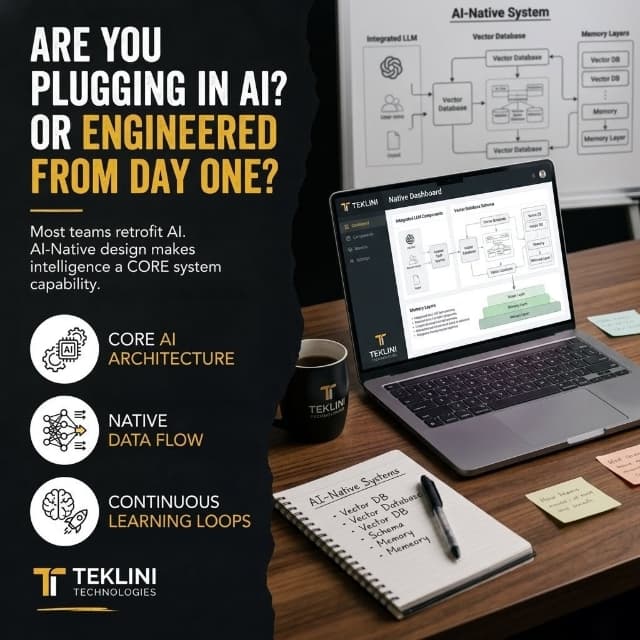
There is a clear distinction between software that uses AI and software that is fundamentally designed around AI.
Most teams are still operating in the first category. They retrofit existing systems, add a chatbot layer on top of legacy architecture, and label it AI-powered. The underlying system logic remains unchanged. The data flow remains rigid. The product still behaves like traditional software with an external intelligence plug-in.
AI-native development starts from a different premise.
It asks a sharper question: if intelligence were a core system capability from day one, how would the architecture be designed?
That shift changes everything. It influences database design, system interfaces, event handling, and how decisions are delegated between deterministic logic and probabilistic models. It also introduces continuous learning loops where systems evolve based on interaction data rather than static rule updates.
At Teklini Technologies, I approach system design from this foundation. LLM integration, vector storage systems, tool-calling architectures, and AI memory layers are treated as core infrastructure components, not external features.
This is where the industry is moving. The competitive gap is no longer between companies that use AI and those that do not. It is between those that design for AI at the architectural level and those that treat it as an enhancement layer.
The real question is simple. Are you embedding AI into existing software, or are you engineering systems that assume AI is part of their core operating model from the start?
#SoftwareDevelopment #AINative #TekliniTechnologies